
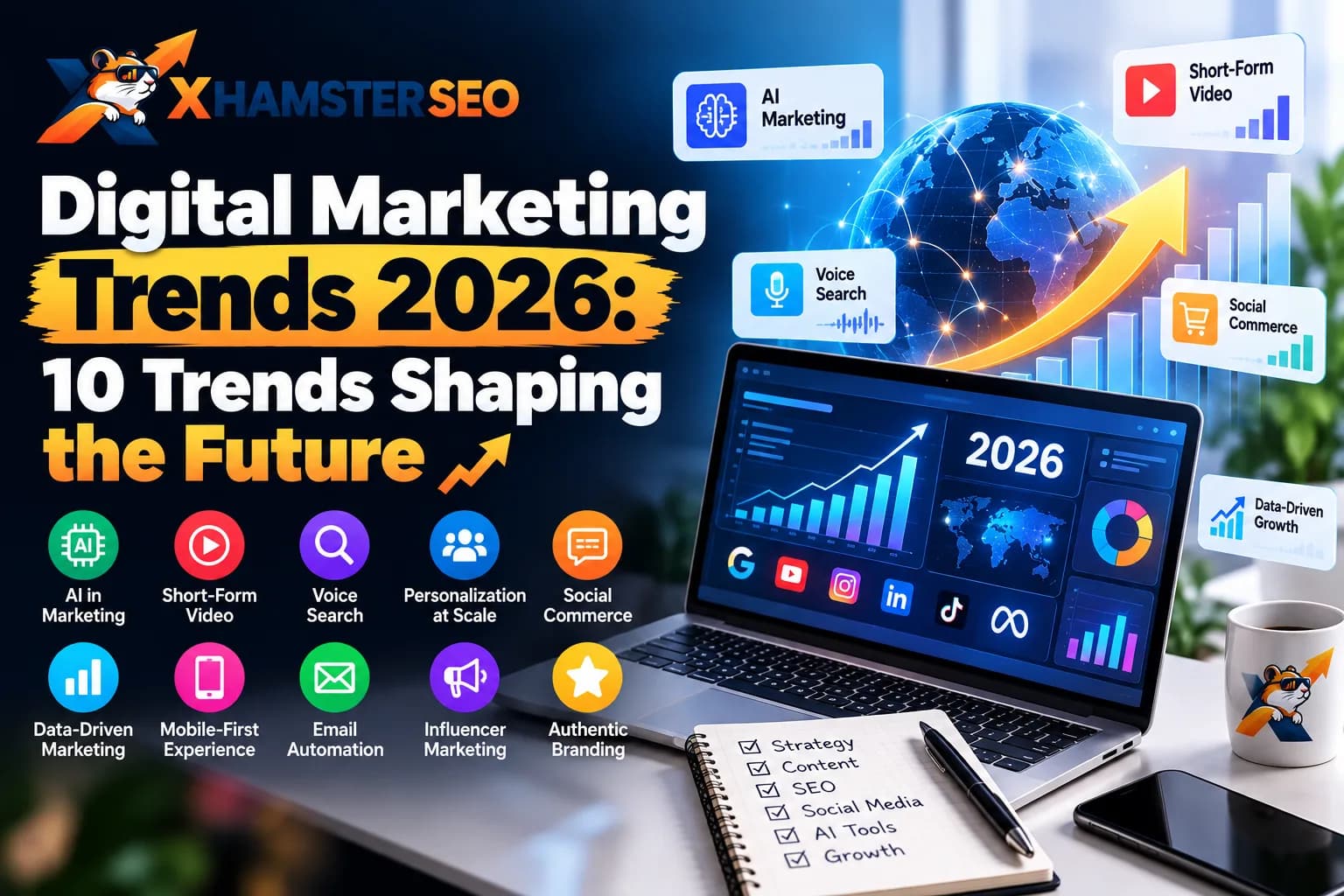
Digital Marketing Trends for 2026: 10 Trends Shaping the Future
Digital marketing is changing faster than ever. The strategies that worked a few years ago are no longer enough on their own. Artificial intelligence is transforming how businesses build campaigns, analyze audiences, personalize customer experiences, and manage advertising. Simultaneously, consumers are discovering brands across AI-powered search engines, short-form videos, creators, social platforms, and conversational messaging apps.
In 2026, digital marketing is shifting from simply competing for attention to building unified systems that seamlessly connect discovery, engagement, personalization, conversion, and measurement.
Research from Google, HubSpot, and Experian underscores AI, changing search habits, first-party data, and conversational commerce as the primary forces defining growth this year. For businesses, staying competitive requires strategies that are adaptable, data-driven, and focused on delivering exceptional customer experiences.
1. AI Is Now a Core Foundation of Digital Marketing
Artificial intelligence is no longer an experimental toy for marketers. In 2026, companies are integrating AI across every layer of their marketing stack, including:
- Content creation and iteration
- Audience research and persona building
- Full-funnel campaign planning
- Dynamic ad creative generation
- Customer segmentation and predictive scoring
- Real-time dynamic personalization
- Marketing automation and agentic workflows
- Predictive data analysis
- Automated conversational customer support
- Autonomous bid and campaign optimization
According to Experian’s 2026 digital marketing research, 94% of marketers are making broad investments in AI to improve operational efficiency and maximize business impact. Modern AI tools analyze massive data sets, surface hidden patterns, generate creative variations, and automate repetitive workflows.
What businesses should do: Avoid using AI solely to inflate publishing volume. Shift from raw content generation to optimizing the entire marketing lifecycle: Research → Create → Test → Analyze → Refine. Human strategic oversight remains indispensable for brand voice, factual accuracy, creative direction, and relationship building.
2. AI-Powered Search Is Changing SEO (AEO & GEO)
The mechanics of organic discovery are undergoing a profound evolution. Searchers increasingly rely on conversational interfaces and generative AI engines to research topics, compare products, and obtain direct answers.
Google's marketing outlook highlights this shift from simple keyword fact-finding to multi-turn conversational exploration. HubSpot’s 2026 research indicates that 40.6% of marketers view adapting SEO for AI search as their top priority.
Modern organic visibility spans a diverse ecosystem:
- Traditional Google Search
- Google AI Overviews
- AI-powered search engines (Perplexity, SearchGPT)
- Chat-based assistants
- YouTube search
- Social search across TikTok and Instagram
- Specialized vertical search platforms
Traditional SEO focused heavily on matching exact-match keywords. Today, winning in search requires content optimized for Answer Engine Optimization (AEO) and Generative Engine Optimization (GEO)—content that answers queries directly, demonstrates verified first-hand expertise, provides concise context, uses clear semantic HTML hierarchy, and supports claims with authoritative data.
3. First-Party Data Takes Center Stage
Third-party cookies and rented audience data are increasingly unreliable and restricted. As a result, businesses are prioritizing owned first-party data collected directly through direct customer interactions:
- Opt-in email subscribers
- Verified customer purchase history
- On-site interaction and behavioral tracking
- CRM logs and pipeline records
- Mobile app engagement metrics
- Loyalty program activities
- Lead qualification form submissions
- Explicit customer preference centers
Experian reports that 70% of B2B marketers are actively expanding their first-party data repositories. Building owned data assets empowers businesses to segment repeat buyers, target high-LTV cohorts, re-engage abandoned carts, and customize retention workflows without relying on external ad algorithms.
4. Short-Form Video Remains a Dominant Growth Engine
Short-form video continues to dominate brand discovery across Instagram Reels, YouTube Shorts, TikTok, and Facebook Reels. In high-growth digital markets like India, Meta’s research indicates video-first discovery has become an essential pillar of the modern shopping journey.
Short-form video excels at packaging high-impact information into bite-sized visual formats:
- Rapid product demonstrations and unboxings
- Actionable mini-tutorials and tips
- Authentic customer case studies and reviews
- Behind-the-scenes company culture
- Educational industry breakdowns
- Compelling before-and-after transformations
Instead of chasing fleeting viral audio trends, build video clusters around exact customer pain points. Address specific questions, common mistakes, tool walkthroughs, and tactical comparisons to turn video viewers into qualified site traffic.
5. Social Commerce Shortens the Conversion Funnel
Social media has evolved far beyond passive brand awareness into direct transactional platforms supporting the entire buying lifecycle: Discovery → Consideration → Conversation → Purchase.
Key pillars driving social commerce include:
- Directly shoppable posts and videos
- In-app product catalog tagging
- Creator-tagged product recommendations
- Click-to-message conversational ads
- Native live shopping streams
- Frictionless in-platform checkout
Ensure social profiles function as secondary storefronts where prospects can view pricing, ask questions via direct messaging, and complete transactions with minimal friction.
6. Strategic, Creator-Led Marketing Replaces Vanity Endorsements
Broad celebrity endorsements are increasingly giving way to specialized creator partnerships. Brands are partnering with niche subject-matter authorities whose audiences demonstrate high trust and engagement:
- Niche micro-influencers (10k–50k targeted followers)
- Local and regional community leaders
- B2B practitioners and technical experts
- User-Generated Content (UGC) specialists
- Actual verified brand power-users
Evaluate creator campaigns on commercial business metrics—such as engagement quality, referral click-throughs, lead volume, and Customer Acquisition Cost (CAC)—rather than superficial follower counts.
7. Intelligent, Predictive Personalization
Consumers expect dynamic experiences tailored to their exact stage in the buyer journey. Powered by machine learning and first-party data, personalization in 2026 adapts experiences based on:
- Past transaction history and replenishment cycles
- Real-time intent signals and browsing behavior
- Geographic location and localized inventory
- Customer lifecycle phase (lead, first-time buyer, VIP)
- Cross-channel engagement history
Personalization should streamline the customer experience, delivering tailored solutions and valuable resources rather than intrusive, surveillance-style advertisements.
8. Conversational Commerce & WhatsApp Marketing Expansion
Direct messaging has become a primary driver of customer acquisition and retention. In mobile-first markets like India, WhatsApp serves as a central hub for business communication, bridging the gap between social discovery and transaction.
Effective conversational workflows include:
- Instant lead qualification and inquiry routing
- Personalized product recommendations
- Order tracking and shipping notifications
- Automated appointment and demo scheduling
- Targeted re-engagement and limited-time offers
- Post-purchase customer support
Integrating your social ads directly with WhatsApp, your CRM, and your eCommerce platform establishes an agile conversion funnel that bypasses long, drop-off-heavy checkout processes.
9. Marketing Automation & Agentic AI Workflows
Automation has advanced beyond simple "if-this-then-that" email triggers into autonomous, multi-step AI agents. These systems handle complex, repetitive tasks without manual oversight:
- Automated inbound lead scoring and routing
- Dynamic multi-branch email nurturing
- Multi-channel content distribution
- Continuous ad performance auditing and budget reallocation
- Synthesized cross-channel reporting and anomaly alerts
Offloading administrative tasks to AI workflows frees marketing teams to dedicate their energy to competitive positioning, high-level creative execution, and customer research.
10. Full-Funnel Attribution & Business Outcome Measurement
Vanity traffic metrics are insufficient for modern marketing teams. Growth leaders in 2026 evaluate marketing performance through unified data frameworks that tie activity directly to revenue:
- Awareness: Targeted reach, video completion rates, organic branded search volume
- Engagement: Scroll depth, returning visitor frequency, community interactions
- Acquisition: Cost Per Lead (CPL), landing page conversion rate, Customer Acquisition Cost (CAC)
- Revenue: Return on Ad Spend (ROAS), Customer Lifetime Value (LTV), pipeline velocity
Connect campaign tracking directly into CRM and business intelligence systems to clearly understand which channels drive profitable customer acquisition.
Key Digital Marketing Trends in India for 2026
India’s digital landscape requires localized, mobile-first strategies. Consumers frequently discover products via video, interact through chat, and purchase across omnichannel touchpoints. Key priorities include:
- Short-form video content across Instagram Reels and YouTube Shorts
- Regional-language (vernacular) SEO and creative campaigns
- Deep WhatsApp Business API and conversational funnel integration
- Tier-2 and Tier-3 creator partnerships
- Hyper-local SEO and Google Business Profile management
How to Build a High-ROI Marketing Strategy for 2026
- Step 1: Understand Your Audience: Audit where your ideal prospects research problems, which platforms they trust, and what friction slows down their purchase decisions.
- Step 2: Strengthen Your Owned Web Assets: Ensure your website loads quickly, satisfies Core Web Vitals, uses clear semantic structured data, and answers questions comprehensively for both human visitors and AI search engines.
- Step 3: Capture First-Party Data: Build owned subscriber lists across email, CRM, and WhatsApp to protect your pipeline from ad platform volatility.
- Step 4: Repurpose Content Efficiently: Maximize every asset by transforming one core piece of research into a long-form article, YouTube video, short-form clips, LinkedIn insights, and an email newsletter.
- Step 5: Deploy AI with Human Oversight: Use AI tools to accelerate research, draft variations, and automate workflows while relying on experienced marketers for brand voice, strategy, and factual accuracy.
- Step 6: Measure Revenue, Not Just Clicks: Track user journeys from initial impression to paid conversion to invest confidently in top-performing channels.
Digital Marketing Trends 2026: Quick Summary
| Trend | What Is Changing? | Strategic Priority |
|---|---|---|
| AI Marketing | Embedded into daily operational workflows | Workflow automation + strategic oversight |
| AI-Powered Search | Shifting toward conversational, synthesized answers | Technical SEO + AEO & GEO topic modeling |
| First-Party Data | Cookie deprecation and privacy regulations | Owned CRM data + opt-in communities |
| Short-Form Video | Visual-first discovery driving brand awareness | Intent-driven Reels, Shorts & mini-guides |
| Social Commerce | In-app native product research and checkout | Frictionless storefronts + shoppable media |
| Creator Marketing | Shift toward authentic, niche authorities | Performance-driven creator partnerships |
| Intelligent Personalization | Dynamic customer experiences at scale | Lifecycle segmentation + behavioral triggers |
| Conversational Messaging | Chat apps serving as primary conversion paths | WhatsApp API + automated CRM integration |
| Agentic Automation | Multi-step workflows managed by AI agents | Repetitive task automation + rapid execution |
| Full-Funnel Measurement | Pressure for transparent, verifiable attribution | Pipeline revenue & LTV measurement |
Frequently Asked Questions
What are the most critical marketing trends in 2026?
The most important trends are AI marketing workflows, generative engine search optimization (AEO/GEO), first-party data capture, short-form video discovery, conversational WhatsApp commerce, and closed-loop revenue attribution.
Is SEO still relevant in 2026?
Yes. Organic search remains one of the highest-converting digital channels. However, optimization strategies have expanded beyond traditional 10 blue links to include AI Overviews, generative answer engines, and semantic topic clusters.
What is Answer Engine Optimization (AEO)?
AEO involves structuring and writing content so conversational AI engines (like Google Gemini, SearchGPT, and Perplexity) can parse, cite, and present your business as the definitive answer to specific user queries.
What should small businesses prioritize first?
Small businesses should focus on the essentials: technical website health, localized search optimization, direct customer messaging (like WhatsApp), helpful short-form video, and capturing first-party email or CRM data.
Closing Takeaways
Digital marketing in 2026 is faster, more conversational, and heavily integrated with artificial intelligence. While platforms and algorithms evolve, the fundamental goal remains consistent: deeply understanding customer intent, delivering immediate value, building authentic trust, and evaluating performance through tangible business revenue.
The winning growth framework for 2026 follows a clear cycle: Understand → Create → Distribute → Personalize → Automate → Measure → Improve.
Want results like these for your website?
Our team will review your site and share a clear plan to grow your rankings, traffic and leads.
Was this article helpful?
Your feedback helps our editorial research team create better, data-driven playbooks.