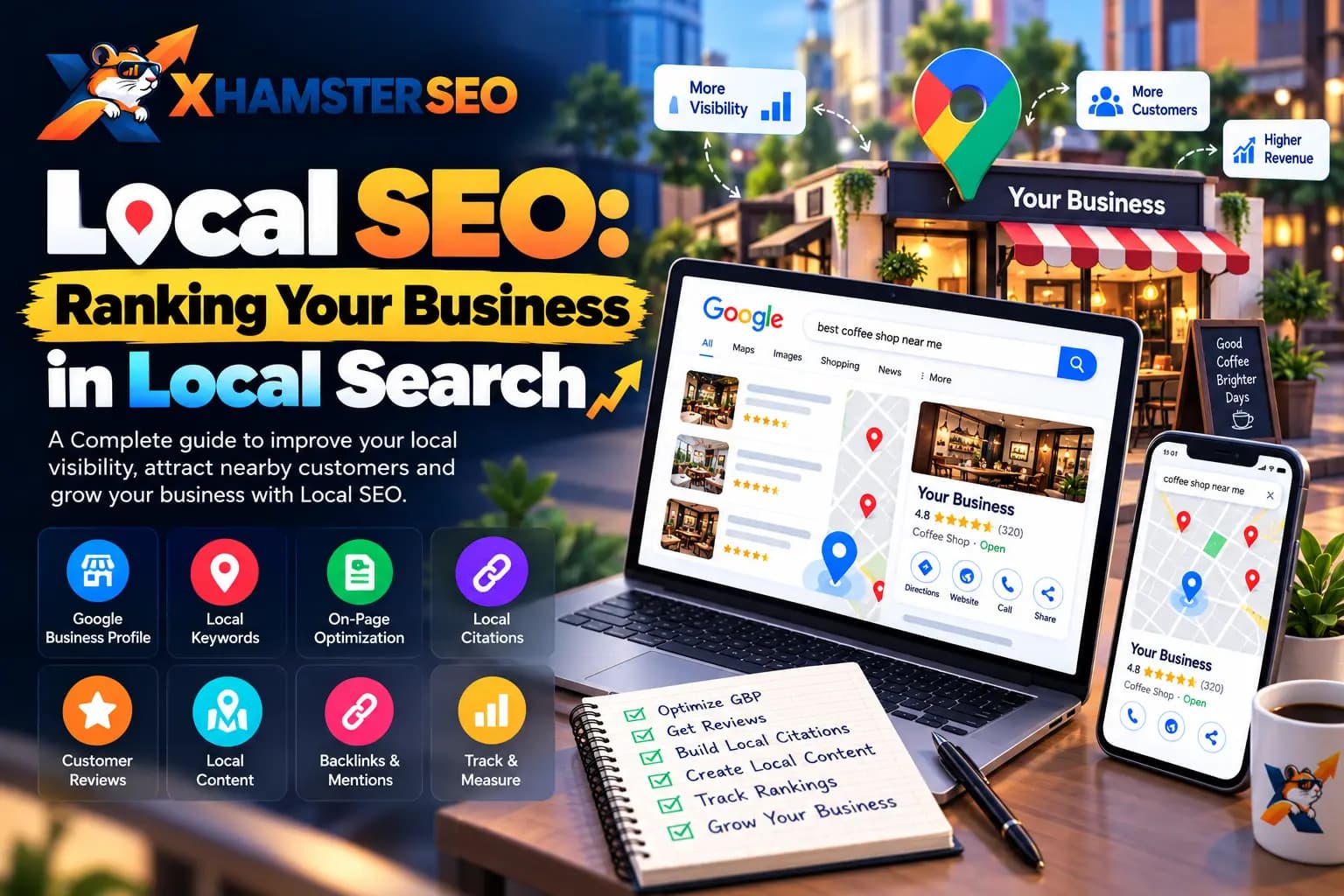
If you run a local business, getting found by customers in your area can be just as important as ranking for broad keywords.
Someone searching for:
"SEO agency near me"
or
"best dentist in Lucknow"
isn't simply looking for information.
Instead of merely gathering information, they are likely seeking a nearby business to reach out to or visit.
This is where Local SEO becomes important.
Local SEO helps businesses improve their visibility when people search for products, services, or businesses connected to a specific location.
For local businesses, maintaining a strong presence in local search results can drive key outcomes, including:
- Website visits
- Phone calls
- Directions
- Enquiries
- Store visits
- Bookings
- Leads
- Sales
In this guide, we covers the fundamentals of local SEO, Google Business Profile optimization, tactics for boosting Google Maps visibility, and actionable strategies for competing in local search rankings.
What Is Local SEO?
Local SEO focuses on enhancing an organization's digital prominence for search queries tailored to a particular geographical region.
For example:
- SEO agency in Lucknow
- dentist near me
- restaurants in Delhi
- car repair shop in Kanpur
- digital marketing agency near me
Unlike traditional SEO, which can target users anywhere in the world, local SEO focuses on reaching people in a particular location.
Google's local search systems use information about businesses and the searcher's context to determine which local results are relevant. According to Google, three core factors determine local search rankings: relevance, distance, and prominence.
Why Is Local SEO Important?
Consider two businesses.
Business A
Has:
- A basic website
- No optimized Google Business Profile
- Few reviews
- Inconsistent business information
Business B
Has:
- An optimized Google Business Profile
- Accurate business information
- Strong reviews
- Location-specific content
- Relevant local links
- Consistent citations
When someone searches for a relevant service in that area, Business B has more signals supporting its local visibility.
By optimizing for local SEO, businesses can connect with potential clients at the exact moment they search for nearby services.
This makes local search particularly valuable for businesses with physical locations or defined service areas.
How Does Local SEO Work?
According to Google, three primary factors drive rankings in local search results:
Relevance
How deeply a business aligns with the user's search intent.
Distance
The proximity of the business relative to where the user is currently located or the specific geographic destination included in their query.
Prominence
How well-known or established the business appears to be based on information Google can identify across the web.
Think of local SEO as:
Relevance + Location + Business Prominence
You cannot completely control all three factors, but you can improve many of the signals that help Google understand your business.
1. Optimize Your Google Business Profile
A Google Business Profile serves as a cornerstone of any effective local SEO strategy.
Businesses can use Google Business Profile to control their presence and information across Google Maps and Search.
To maximize the completeness and accuracy of your listing, ensure it includes essential details such as:
- Business name
- Primary category
- Address
- Phone number
- Website
- Business hours
- Services
- Business description
- Photos
According to Google, maintaining accurate and comprehensive business details enables customers to better evaluate your company while improving profile visibility for relevant local searches.
Choose the Right Business Category
Your primary category should accurately represent your main business.
For example:
A dental clinic shouldn't select a generic category when a more specific and accurate category is available.
Selecting an accurate primary category assists Google in recognizing the core focus of your operations. For instance, a dental practice ought to choose a precise classification rather than a generic one.
2. Keep Your Business Information Consistent
Ensuring your business details match across your site and third-party platforms is essential.
Important information includes:
- Name
- Address
- Phone number
This is often referred to as NAP consistency.
For example:
ABC Digital Marketing
123 Main Road, Lucknow
+91 XXXXX XXXXX
Avoid having significantly different versions across directories and websites.
Consistency helps create a clearer digital footprint for your business.
3. Get More Genuine Customer Reviews
Customer reviews play a vital role in influencing purchasing decisions and enhancing local search prominence.
Google says that more reviews and positive ratings can help improve a business's local ranking.
But businesses should focus on genuine customer reviews, not fake or manipulated reviews.
You can encourage customers to leave feedback after:
- Completing a purchase
- Finishing a service
- Visiting your store
- Completing a project
- Receiving an order
Make the process easy.
For example:
Purchase → Follow-up → Review Request
4. Respond to Reviews
Don't simply collect reviews.
Respond to them.
Thank customers for positive feedback.
If someone raises a concern, respond professionally and try to address the issue.
Replying demonstrates to prospective clients that your company is attentive and actively interacts with its audience.
They also provide an opportunity to reinforce your business's professionalism.
Avoid using every review response as an opportunity to stuff keywords.
Write naturally.
5. Build Local Citations
A local citation is a mention of your business's information on another website.
Citations can appear on:
- Business directories
- Industry websites
- Local directories
- Chamber of commerce websites
- Review platforms
- Local publications
For example:
Business Name
Address
Phone
Website
Rather than submitting your listing to countless arbitrary directories, prioritize building entries on reputable and authoritative platforms.
Focus on relevant and trustworthy platforms.
6. Create Location-Specific Website Content
It is essential that your website explicitly indicates your geographic area of operation.
For example, an SEO agency serving Lucknow could have:
/seo-services-lucknow/
and potentially supporting pages for specific services.
However, don't create dozens of almost identical location pages simply by replacing the city name.
Instead, make each location page genuinely useful.
Include:
- Local service information
- Areas served
- Customer questions
- Local examples
- Relevant testimonials
- Business information
- Unique content
Providing distinct value encourages users to visit each page.
7. Target Local Keywords
Keyword research for local SEO should include location modifiers.
For example:
Service Keyword
SEO services
Local Keyword
SEO services in Lucknow
Local Long-Tail Keyword
top SEO agency for small businesses located in Lucknow
Other modifiers may include:
- Near me
- In [city]
- [service] near [location]
- Best [service] in [city]
- [service] [neighborhood]
Don't force these phrases into every sentence.
Use them naturally where they accurately describe the service.
8. Optimize Your Website for Local Search
Ensure the content on your site presents details about your company clearly and accessibly.
Important elements include:
Title Tags
Example:
SEO Services in Lucknow | XhamsterSEO
Meta Description
Clearly explain the service and location.
H1
Example:
SEO Services in Lucknow
Contact Information
Ensure your phone number and address are straightforward and easy for visitors to locate.
Location Pages
Create useful pages for important service areas.
Internal Links
Connect location pages with relevant service pages.
9. Add Local Business Schema
By implementing structured data, search engines can gain a clearer understanding of your business details.
Depending on the business, relevant structured data may include:
LocalBusinessOrganizationPostalAddressGeoCoordinatesOpeningHoursSpecification
On-page structured data must precisely reflect the content accessible to visitors.
Avoid adding details purely to manipulate search engine rankings.
The markup should reflect the actual business.
10. Build Local Backlinks
Acquiring backlinks from location-relevant websites can enhance your local search visibility.
Potential sources include:
- Local news websites
- Business associations
- Community organizations
- Local blogs
- Industry publications
- Event websites
- Local partnerships
For example, a Lucknow-based company sponsoring a local event might receive a mention from the event organizer's website.
The goal should be relevance and genuine relationships, not buying large quantities of low-quality links.
11. Create Locally Relevant Content
Local content can help establish relevance around a geographic area.
For example, a real estate company could publish:
- Best residential areas in Lucknow
- Lucknow property buying guide
- Upcoming residential developments
- Cost of living in Lucknow
- Guide to buying property in Gomti Nagar
A fitness business could publish:
- Running routes in Lucknow
- Fitness events in Lucknow
- Beginner's fitness guide for local residents
Ensuring the material offers genuine value to local residents is essential.
12. Optimize for "Near Me" Searches
"Near me" searches are strongly connected with local intent.
Examples include:
- restaurants near me
- gyms near me
- SEO agency near me
- dentist near me
- car repair near me
There is no necessity to build a dedicated page named:
"Best SEO Agency Near Me"
just because users search that phrase.
Instead, focus on making your business information accurate, your location clear, your Google Business Profile complete, and your website locally relevant.
When serving local search results, Google factors in the user's physical location along with additional context-based signals.
13. Make Your Website Mobile-Friendly
Because people often perform local searches while on the move, maintaining a mobile-friendly site is crucial.
Imagine someone searching for:
"coffee shop near me"
on their smartphone.
They may want to:
- Call the business
- Get directions
- Check opening hours
- Visit the website
- Read reviews
Delivering a smooth mobile experience across your website is crucial.
Important areas include:
- Responsive design
- Fast loading
- Easy navigation
- Click-to-call phone numbers
- Simple contact forms
- Clear location information
14. Improve Your Local Landing Pages
A local landing page should provide useful information rather than simply repeating a city name.
A strong page might include:
H1
SEO Services in Lucknow
Introduction
Explain your services and who you serve.
Services
List relevant SEO services.
Local Expertise
Explain your experience serving businesses in the region.
Case Studies
Show relevant results where appropriate.
Testimonials
Include genuine customer feedback.
FAQs
Answer location-specific questions.
Contact CTA
Ensure potential clients can reach you effortlessly.
This creates a much more useful experience than a page containing only a few paragraphs and a city keyword.
15. Use Local Reviews and Testimonials
Customer testimonials can strengthen both trust and conversion.
Where appropriate, include:
- Customer name
- Business name
- Service provided
- Genuine testimonial
For example:
"XhamsterSEO helped us improve our organic visibility and generate more qualified enquiries."
Don't create fake testimonials.
Authenticity matters.
16. Integrating Local Content into Your Content Strategy
Local SEO shouldn't exist separately from your broader content strategy.
Create a content funnel:
For example:
This allows informational content to naturally support commercial pages.
17. Track Local SEO Performance
You can't improve what you don't measure.
Important metrics include:
Google Business Profile
Monitor available profile performance data such as interactions and customer actions.
Organic Traffic
Monitor visitors from local search.
Search Impressions
Track how often your pages appear.
Calls
Measure calls generated through your website or business profile.
Directions
For physical businesses, direction requests can be useful.
Leads
Track:
- Forms
- Calls
- Bookings
- Enquiries
Rankings
Monitor important local queries and map visibility.
Don't focus on rankings alone.
The real objective is:
Local Visibility → Traffic → Leads → Customers
Local SEO vs Traditional SEO
| Traditional SEO | Local SEO |
|---|---|
| Can target global audiences | Focuses on specific geographic areas |
| Targets broader search queries | Targets location-based searches |
| Organic search visibility | Local Search + Maps visibility |
| Content and backlinks are important | GBP, reviews, citations, local relevance also matter |
| Useful for online businesses | Particularly valuable for local businesses |
The two strategies aren't mutually exclusive.
A local business can benefit from both traditional organic SEO and local SEO.
Local SEO Checklist
Google Business Profile
- Claim and verify your profile
- Choose the correct primary category
- Add accurate business information
- Add services
- Add business hours
- Upload high-quality photos
- Keep information updated
- Respond to reviews
Website
- Optimize title tags
- Create useful location pages
- Add local keywords naturally
- Display contact information
- Improve mobile experience
- Add internal links
- Implement relevant structured data
Local Authority
- Build relevant citations
- Earn genuine reviews
- Get relevant local backlinks
- Participate in local communities
- Create useful local content
Measurement
- Track organic traffic
- Monitor local visibility
- Track calls
- Track enquiries
- Monitor conversions
- Review performance regularly
Common Local SEO Mistakes
1. Keyword Stuffing
Don't write:
"Best SEO company in Lucknow providing SEO services in Lucknow for businesses looking for SEO services in Lucknow."
It sounds unnatural and provides little value.
Use location terms naturally.
2. Creating Duplicate Location Pages
Creating 50 nearly identical pages for different cities can create low-value content.
Every key location page ought to deliver practical, original, and valuable details.
3. Ignoring Reviews
Collecting genuine feedback and online ratings is vital for establishing trust with consumers and strengthening search rankings in your target area.
Create a process for requesting genuine feedback.
4. Inconsistent Business Information
Discrepancies in business details across different platforms can lead to confusion.
Keep important business details accurate and consistent.
5. Buying Fake Reviews
Fabricated feedback can erode credibility and breach platform guidelines.
Build reviews through real customer experiences.
6. Focusing Only on Google Maps
Local SEO is broader than Maps.
Multiple elements shape your local search presence beyond just Google Maps, including your site, customer feedback, directory citations, incoming links, and localized content.
7. Ignoring Mobile Users
Because mobile devices account for a significant share of local search queries, optimization for handheld users is essential.
Make it easy for visitors to call, navigate, book, or contact you.
Frequently Asked Questions
What is Local SEO?
Local SEO optimization focuses on enhancing a business's online search presence within a targeted geographic location.
How can I improve my local SEO?
Start by optimizing your Google Business Profile, keeping business information accurate, earning genuine reviews, creating useful local content, improving your website, building relevant citations and earning local links.
How do I rank higher on Google Maps?
Local search visibility is largely shaped by three core factors according to Google: relevance, distance, and prominence. You can boost your local rankings by refining your business details, maximizing relevance, cultivating customer reviews, strengthening your site, and building overall online authority.
Why a Google Business Profile Matters for Local SEO
Having a Google Business Profile plays a crucial role in local SEO, as it enables companies to control and refine the information displayed across Google Search and Maps.
What is the required number of reviews for Local SEO?
Rather than striving for a specific number of reviews to secure a top spot, prioritize acquiring authentic feedback regularly while delivering exceptional service to your clients.
Does Local SEO work for small businesses?
Yes. Local SEO can be particularly valuable for businesses that serve specific geographic areas, including service providers, retailers, restaurants, clinics and professional services.
How long does Local SEO take?
There is no fixed timeframe. Timeline and outcomes differ depending on local market competition, location, authority of your website, overall business prominence, customer reviews, current online footprint, and the thoroughness of optimization efforts.
Final Thoughts
Effective local SEO requires far more than merely incorporating location names into your site content.
At its core, local SEO focuses on ensuring that both search engines and potential clients can easily recognize your brand, core offerings, service areas, and local relevance.
A strong local SEO strategy combines:
Google Business Profile + Relevant Website Content + Reviews + Local Citations + Local Links + Technical SEO + Measurement
- Start with the fundamentals.
- Make your business information accurate.
- Optimize your Google Business Profile.
- Create useful location-specific content.
- Earn genuine customer reviews.
- Build relevant local authority.
- Then measure the results and continuously improve.
Succeeding with local SEO requires much more than simply sprinkling geographical keywords across your pages. Fundamentally, it centers on helping search engines and prospective customers clearly understand your business identity, services, coverage areas, and local significance.
A well-rounded local SEO approach integrates several key components:
- Google Business Profile Management
- Location-Relevant Website Content
- Authentic Customer Reviews
- Consistent Local Citations & Backlinks
- Technical SEO & Performance Measurement
To get started, focus on these essential steps:
- Verify and complete your Google Business Profile.
- Ensure your core business details are accurate and uniform.
- Develop high-value content tailored to your target areas.
- Collect genuine feedback from your clientele.
- Establish trustworthy local connections and domain authority.
- Continuously track performance metrics and adjust your tactic.
Ultimately, the objective extends beyond merely showing up in search results. The true purpose is converting online exposure into tangible growth:
Search Discovery → Site Visit → Direct Call → Inquiry → Paying Customer
It's to turn that visibility into:
Search → Visit → Call → Enquiry → Customer
Want results like these for your website?
Our team will review your site and share a clear plan to grow your rankings, traffic and leads.
Was this article helpful?
Your feedback helps our editorial research team create better, data-driven playbooks.