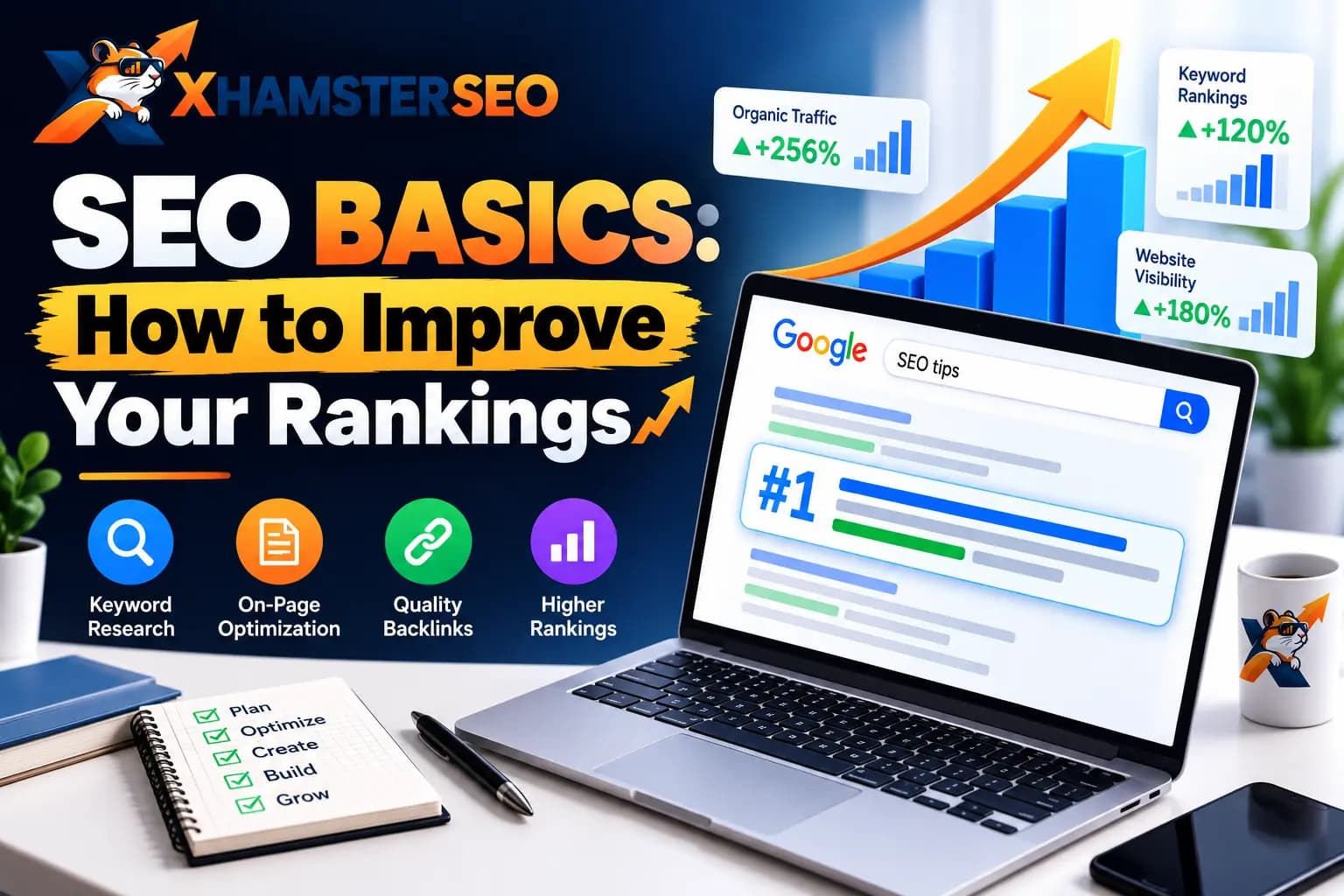
SEO Basics: How to Improve Your Google Rankings
One of the most significant sources of website traffic is search engines. Whether you run a business website, blog, ecommerce store, or service website, appearing prominently in Google Search can help more people discover your brand.
But ranking higher on Google is not simply about adding keywords to a page. Understanding search intent, producing helpful content, optimizing the structure of your website, enhancing technological performance, obtaining relevant links, and making it simple for search engines to scan and comprehend your website are all components of modern SEO.
If you're new to search engine optimization, this guide covers the SEO basics you need to know to improve your website rankings and grow organic traffic.
What Is SEO?
The process of making a website and its content better so that search engines can better comprehend, find, and display it to users looking for pertinent information is known as SEO, or search engine optimization.
For example, if someone searches for:
"best digital marketing agency in Lucknow"
Google needs to determine which pages are most relevant and useful for that search. SEO helps your website communicate its relevance while also improving the experience for visitors.
SEO generally includes three major areas:
- On-page SEO
- Technical SEO
- Off-page SEO
A successful SEO strategy usually combines all three.
How Does SEO Work?
Search engines use automated systems to discover and understand webpages. Google crawls websites using automated crawlers such as Googlebot. The information discovered during crawling can then be processed and indexed so that relevant pages can appear for search queries.
The basic process can be simplified into: Crawling → Indexing → Ranking → Search Outcomes
1. Crawling
Search engines discover webpages by following links and accessing URLs. If search engines cannot properly access important pages, those pages may have difficulty appearing in search results.
2. Indexing
After discovering a page, Google analyzes its content and other information to determine whether and how it should be stored in its index.
3. Ranking
When someone searches for something, Google's systems determine which indexed pages are relevant to the query and how they should be displayed. This is why SEO isn't about simply "adding keywords." Your page needs to satisfy the searcher's actual need.
Why Is SEO Important?
SEO can help your website:
- Increase organic traffic
- Reach potential customers who are actively searching for the products or services your business provides.
- Generate leads
- Build brand visibility
- Increase online credibility
- Reduce dependence on paid advertising
- Create long-term traffic opportunities
For example, a company selling accounting software could create content around searches such as "accounting software for small businesses", "best accounting software", or "how to manage business expenses." Instead of advertising to everyone, SEO allows the company to reach people already searching for related solutions.
10 SEO Basics to Improve Google Rankings
1. Start With Keyword Research
Keyword research is one of the key building blocks of a successful SEO strategy. Before creating content, identify the words and phrases your target audience actually searches for.
For instance, a web development agency could focus on keywords such as:
- Primary keyword: web development company
- Related keywords: website development services, custom web development, web development agency
- Long-tail keywords: web development company for small businesses, affordable web development services, custom website development company
Avoid choosing keywords based solely on their search volume. You should also consider search intent, competition, relevance, business value, keyword difficulty, and existing search results.
2. Understand Search Intent
Search intent means understanding why someone is searching for a particular keyword. Most searches can broadly be categorized as:
- Informational Intent: The user wants information (e.g., "what is SEO", "how does SEO work").
- Commercial Investigation: The user is exploring different options before deciding (e.g., "best SEO tools", "Ahrefs vs Semrush").
- Transactional Intent: The user is prepared to take the next step (e.g., "buy SEO software", "hire SEO agency").
- Navigational Intent: The user is searching for a specific website, business, or brand (e.g., "Google Search Console", "Semrush login").
Make sure your content aligns with what users are actually looking for when they search for the keyword.
3. Create Helpful, High-Quality Content
Focus on creating valuable content for your audience rather than writing solely to satisfy search engines. Your content should answer the user's question clearly and provide useful information that adds value.
Good SEO content should:
- Answer the main question
- Be accurate and easy to read
- Include useful examples
- Cover relevant subtopics and provide original insights
- Be updated when information changes
- Avoid unnecessary repetition
4. Optimize Your Title Tag
Your title tag helps search engines and users understand what a webpage is about. Instead of a generic "Home | ABC Company", use something descriptive like: "Expert SEO Agency | SEO Services in Lucknow".
Your title should be relevant, descriptive, concise, written for users, and naturally aligned with the target keyword.
5. Write Better Meta Descriptions
A meta description gives users a brief overview of what a webpage is about. A good meta description should describe the page accurately, include the main topic naturally, encourage relevant users to click, and match the actual page content. Don't stuff keywords into the description.
6. Optimize Your Headings
Use a logical heading structure (H1, H2, H3). This helps both readers and search engines quickly understand the content of the article.
7. Improve On-Page SEO
On-page SEO involves optimizing elements on your webpage. Important areas include your title tag, meta description, headings, main content, URLs, internal links, images (and alt text), anchor text, and structured data. Use clear, descriptive URLs that accurately reflect the page content.
8. Build a Strong Internal Linking Structure
Internal links connect pages within your own website. Internal linking guides visitors to relevant pages while helping search engines understand the connections between different sections of your website. Choose clear, descriptive anchor text instead of repeatedly relying on generic phrases like "click here."
9. Improve Technical SEO
Technical SEO focuses on making your website accessible, crawlable, indexable, and technically sound. Important technical SEO elements include:
- XML Sitemap: Helps search engines locate and crawl key pages efficiently.
- Robots.txt: Guides search engine crawlers on which areas to access or avoid.
- HTTPS: Keeps the connection secure and protects user data.
- Mobile-Friendly Design: Ensures your website functions smoothly across all devices.
- Website Speed & Core Web Vitals: Fast-loading pages provide a better user experience.
- Canonical URLs: Helps search engines identify the main version of a page when duplicate content exists.
10. Earn High-Quality Backlinks
Backlinks are links placed on other websites that point visitors to your site. When relevant and trustworthy websites link to your content, those links can contribute to your site's authority and visibility.
Focus on relevant, natural, high-quality links through publishing original research, creating useful resources, digital PR, data-driven content, and genuine partnerships. Avoid manipulative link-building schemes.
SEO vs Paid Advertising
| SEO | Paid Advertising |
|---|---|
| Organic traffic | Paid traffic |
| Long-term strategy | Campaign-based |
| No payment for every organic click | Usually pay per click/impression |
| Requires content and optimization | Requires advertising budget |
| Can compound over time | Traffic often depends on campaign spend |
Many businesses use SEO alongside paid advertising to create a well-rounded digital marketing strategy.
Common SEO Mistakes to Avoid
- Keyword Stuffing: Don't repeatedly insert the same keyword just to increase frequency. Include relevant keywords naturally.
- Publishing Thin Content: Creating many low-value pages simply to target slightly different keyword variations creates a poor user experience.
- Ignoring Search Intent: A page may rank for the right keyword, but it will fall short if the content doesn’t meet what users genuinely expect to find.
- Poor Internal Linking: Important pages should not be buried deep within the website.
- Ignoring Mobile Users: A website that works poorly on smartphones frustrates users and impacts rankings.
- Focusing Only on Rankings: SEO isn't just about achieving position #1. Monitor organic clicks, impressions, CTR, conversions, and revenue.
How Long Does SEO Take to Work?
SEO usually takes time. There isn't a universal timeframe because results depend on factors such as website authority, competition, industry, content quality, technical condition, and search demand. A new website competing for highly competitive keywords may require considerably more effort than an established website targeting low-competition queries.
How to Measure SEO Performance
Google Search Console is a valuable tool for tracking and analyzing your website’s performance in organic search results. Important SEO metrics include:
- Impressions: How many times your webpages appear in the search results.
- Clicks: How many users clicked your search result.
- CTR: The percentage of impressions that resulted in clicks.
- Average Position: An aggregated indication of where your pages appeared.
- Organic Traffic: Visitors arriving through unpaid search results.
- Conversions: Visitors who completed an important action (contact form, purchase, demo request).
Beginner SEO Checklist
Keyword Research
- Identify your target audience and search intent
- Research relevant and long-tail keywords
- Analyze competitors and map keywords to appropriate pages
On-Page SEO
- Optimize title tags, meta descriptions, and URLs
- Use logical headings and add relevant internal links
- Optimize images and use descriptive anchor text
Technical SEO
- Check indexing and submit an XML sitemap
- Review robots.txt and ensure HTTPS is active
- Improve mobile usability and monitor Core Web Vitals
- Fix broken links and check canonical URLs
Content & Off-Page SEO
- Match search intent and answer the main question accurately
- Avoid keyword stuffing and update outdated content
- Build relevant backlinks and promote useful content
Frequently Asked Questions About SEO Basics
What is SEO in simple words?
SEO (Search Engine Optimization) focuses on improving your website so search engines can better understand your content and users can find it through relevant organic searches.
How can I improve my Google ranking?
Start by understanding search intent, targeting relevant keywords, creating genuinely useful content, improving on-page SEO, fixing technical issues, strengthening internal links, and earning relevant backlinks.
Is SEO free?
Organic SEO doesn't require paying Google for each click, but effective SEO usually requires an investment of time, expertise, content, tools, development, or professional services.
How many keywords should you include on a single webpage?
There is no ideal keyword count. Prioritize covering the topic thoroughly and naturally instead of aiming for a specific keyword density. Excessive repetition can become keyword stuffing.
Are backlinks still important for SEO?
Links remain an important part of how search engines discover and understand webpages, but SEO success shouldn't be reduced to backlink quantity. Relevance, content quality, technical accessibility, and user experience also matter.
Does website speed affect SEO?
Page experience and Core Web Vitals are considered by Google's ranking systems, but Google states that there is no single page-experience signal and that excellent Core Web Vitals alone don't guarantee top rankings.
Final Thoughts
SEO becomes much easier to manage once you understand and apply the basic principles. The foundation is straightforward: Research → Draft/Create → Optimize → Improve → Measure.
Create helpful content that directly addresses users' needs, then optimize your pages so search engines can understand and index them effectively. Most importantly, don't try to manipulate search engines with excessive keywords or mass-produced low-value pages. By consistently creating a website that delivers real value, is technically accessible, easy to navigate, and aligned with genuine search intent, you can build a strong foundation for long-term organic growth.
Want results like these for your website?
Our team will review your site and share a clear plan to grow your rankings, traffic and leads.
Was this article helpful?
Your feedback helps our editorial research team create better, data-driven playbooks.